Common Flat Roof Problems on Small Commercial Buildings
Ponding water, failed seams, punctures, and flashing failures are the top flat roof problems on small commercial buildings. Learn what to watch for.
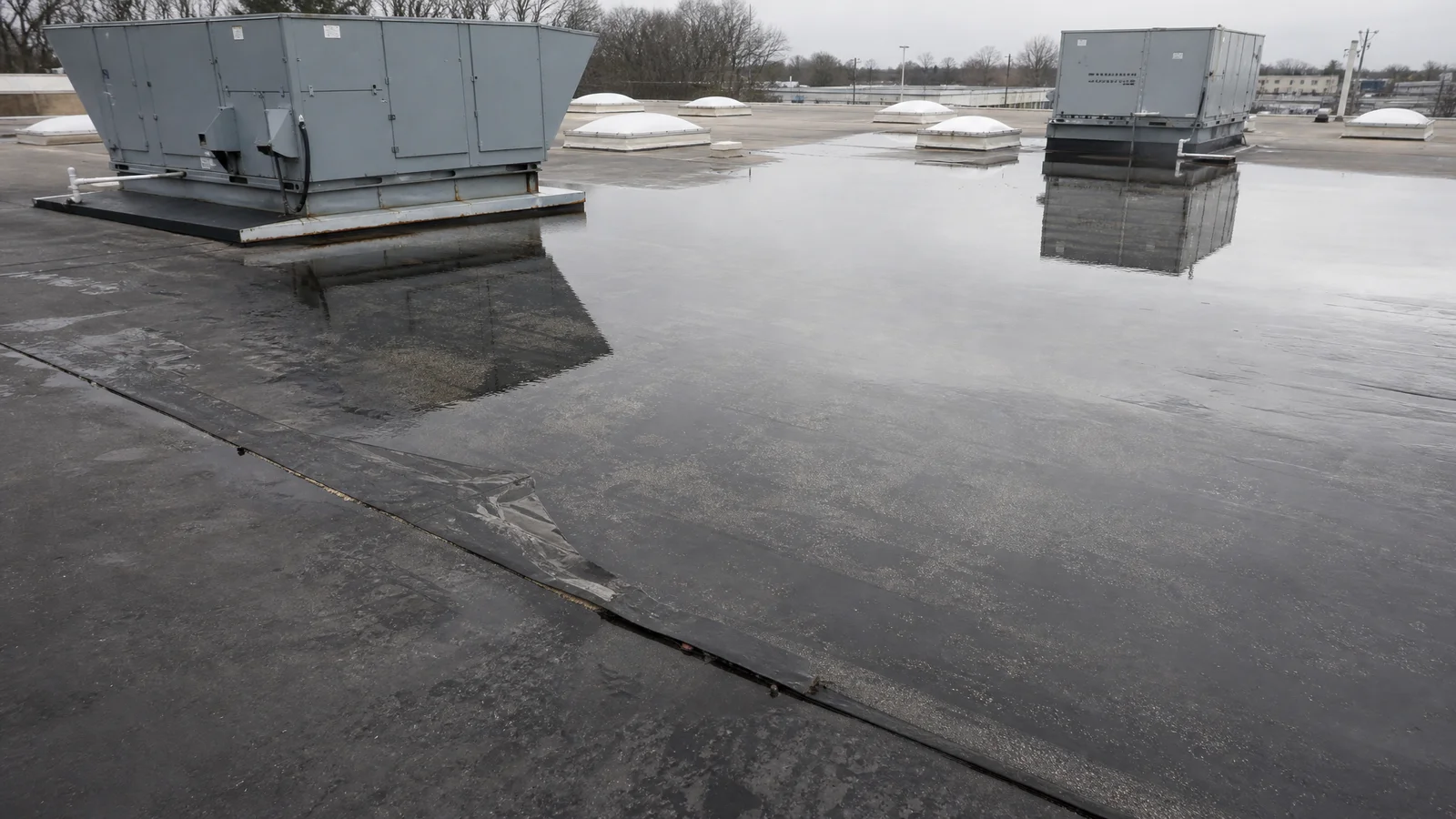
We inspect hundreds of commercial properties across the US each year, and the same handful of flat roof problems pop up repeatedly on small retail shops, warehouses, and offices.
The reality is that these failure modes rarely start as catastrophic blow-offs.
They usually begin with a tiny, overlooked detail that slowly compromises the entire waterproofing system.
Our team will break down the seven most common commercial flat roof issues you will face. Let’s look at the practical causes behind why these leaks happen and walk through exactly how to fix them before they disrupt your business.
1. Ponding water
Ponding water is any moisture that sits on your roof for more than 48 hours after rain stops. It usually stems from insufficient slope, sagging structural joists, or clogged drains.
We see this issue frequently on older flat roofs across the US. Standing water acts like a magnifying glass, accelerating UV degradation on the membrane and breaking down seam adhesives. The added weight also increases the odds of a puncture turning into a massive interior leak.
Our crews often find that older buildings fail to meet current code requirements for proper runoff. The International Building Code (IBC) explicitly mandates a minimum 1/4-inch per foot slope to prevent this exact scenario.
Why It Matters and How to Fix It:
- The danger of flood testing: The National Roofing Contractors Association (NRCA) warns against intentionally flooding a low-slope roof to find leaks, as this can cause irreversible water damage to the insulation.
- Initial repairs: Start by clearing out every clogged drain and scupper.
- Long-term correction: Add tapered polyisocyanurate (polyiso) insulation to correct the slope in specific low spots, or reslope the entire roof deck during a full replacement.
2. Failed membrane seams
Failed membrane seams occur when EPDM glue dries out or factory-welded TPO edges lose their bond over 15 plus years. Because seams are the weakest point of any flat roof, a failure here under standing water will leak immediately.
Our technicians test these seams by running a specialized metal T-probe tool along every edge. A solid TPO heat weld requires specific robotic welder temperatures, usually between 986°F and 1,094°F, to bond correctly. Precision heat application prevents cold welds that easily pop open during winter freezes.
We handle seam restorations based on the specific material installed on your building. Both of the following methods are usually same-day fixes if the surrounding membrane remains sound.
Standard Seam Repair Methods:
- EPDM Rubber: We clean, re-prime, and re-glue the seam with a brand new cover strip.
- TPO Membranes: Technicians re-weld the failing section with specialized hot air hand tools.
- PVC Systems: Similar to TPO, PVC requires localized hot-air welding to restore the watertight seal.
3. Punctures
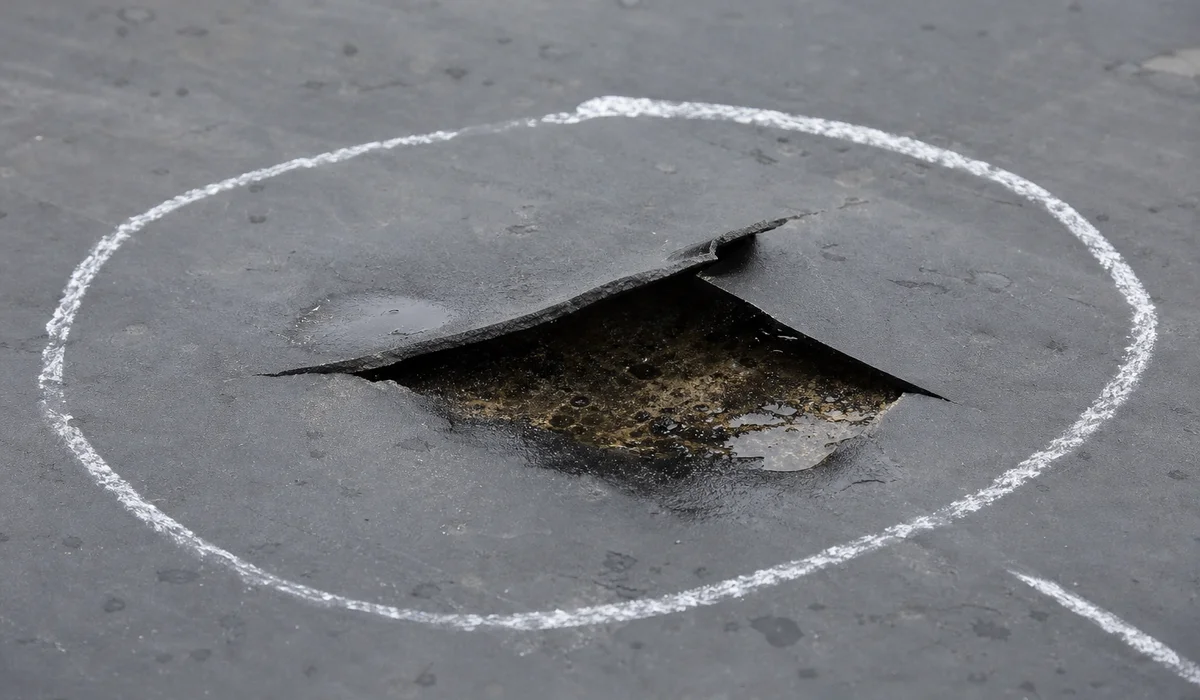
Punctures are holes created by foot traffic damage, dropped HVAC tools, hail impacts, or falling branches. Any hole in the membrane is an active leak waiting to happen, though small cuts often go unnoticed until interior ceiling tiles show water stains.
We frequently discover these small cuts hidden directly around heavy rooftop equipment. Mechanics servicing HVAC units often drop screws or sharp tools, slicing right through standard 45-mil roofing membranes. Upgrading to a thicker 60-mil or 80-mil membrane during your next replacement offers drastically higher puncture resistance.
Our standard commercial repair process depends entirely on the specific material and the size of the hole.
Common Puncture Solutions:
- Self-adhering patches: These work exceptionally well for clean cuts on older EPDM systems.
- Hot-air welded patches: This is the mandatory repair method for any TPO or PVC membrane damage.
- Walkway pads: Adding textured rubber walkway pads around service panels prevents future foot traffic damage from happening in the first place.
4. Flashing failures
Flashing failures happen when the metal perimeter edge lifts or when the seals around HVAC units and pipes separate from the roof deck. These crucial transition points take a brutal beating from severe wind and daily thermal expansion.
Our repair crews constantly replace outdated pitch pockets around electrical conduits and plumbing vents. These metal boxes use a pourable sealant that inevitably shrinks and cracks over time, letting rainwater pour directly into the building structure. The modern, durable fix involves swapping them out for fluid-applied systems or gooseneck pipe housings.
We evaluate the exact failure type before deciding to reseal, re-flash, or entirely replace the failed metal components. Perimeter flashing often lifts directly from the edge metal, while wall flashing separates from the parapet wall or lifts from the roof itself. Penetration flashing fails around rooftop units, vents, and drains.
Comparing Flashing Solutions
| Flashing Type | Expected Lifespan | Common Issues | Best Use Case |
|---|---|---|---|
| Traditional Pitch Pockets | 3 to 5 years | Sealant shrinks, cracks, and requires constant refills | Older, undisturbed existing penetrations |
| Liquid-Applied Flashing | 15 to 20 years | Requires a perfectly dry, clean surface for the initial application | New installations and irregular pipe clusters |
| Gooseneck (Candy Cane) Pipe | 20+ years | Can be tricky to retrofit over existing thick electrical cables | Electrical and heavy refrigerant lines |
5. Ballast displacement (loose-laid EPDM)
Ballast displacement occurs when high winds shift the river rock that holds down a loose-laid EPDM roof. This movement exposes the bare black membrane to the elements and creates heavy point-load stress where the rock piles up deeply.
We see this phenomenon frequently in US coastal regions and areas prone to severe storms. Building codes and ASTM D7655 standards dictate specific river rock sizes, but strong gusts will still migrate the stone over time. The exposed membrane becomes highly vulnerable to tearing and rapid aging from the sun.
Our recommendation is usually a phased approach to fixing the displacement before the membrane fails entirely.
Steps to Correct Displacement:
- Redistribute the rock: Rake the ballast back to the manufacturer’s specified depth across the bare spots.
- Install edge barriers: Add a protective barrier at the roof perimeter to keep the rock safely contained.
- Upgrade the attachment: Transition to a mechanically attached system using plates and heavy-duty fasteners on your next replacement, which performs far better in high wind zones.
6. Adhesive breakdown
Adhesive breakdown leaves portions of the membrane completely loose over the insulation deck. This happens as older glued EPDM and TPO systems age, or if contractors applied adhesives improperly during the initial installation.
We often spot this exact issue when a roof starts billowing or fluttering heavily on a windy day. If the original installer applied solvent-based bonding adhesives outside the recommended 40°F and above temperature window, the glue never cures correctly. The trapped solvents degrade the chemical connection from day one.
Our estimators will map out the loose sections to determine the exact scope of the damage. Small areas can easily be re-adhered using a fresh layer of commercial bonding adhesive. If the breakdown is widespread across the entire deck, it typically points to a mandatory roof replacement.
When to Repair vs. Replace
- Localized bubbling: If only a few edge sections are loose, a quick re-glue is highly effective.
- Widespread billowing: When wind lifts large sections of the center field, the entire adhesive layer has failed.
- Insulation damage: If the loose membrane allowed water to soak the polyiso boards underneath, complete tear-off is required.
7. Ultraviolet damage
Prolonged ultraviolet damage bakes the protective oils and plasticizers right out of your roofing material. TPO membranes are naturally white and reflect UV rays, while black EPDM absorbs the heat and ages much faster, especially on southern exposures.
We use Solar Reflectance Index (SRI) ratings to show clients exactly how much heat their roof absorbs during the day. A standard black EPDM roof can reach surface temperatures exceeding 150°F during peak summer months. This intense heat severely accelerates the chemical breakdown of the rubber.
Our technicians emphasize that UV damage is fundamentally a lifespan issue rather than a localized repair. Extending that lifespan requires a proactive strategy before the membrane becomes too brittle.
Strategies to Combat UV Aging:
- Apply a reflective coating: Rolling on a white silicone or acrylic elastomeric roof coating can cool the surface and extend the lifespan by 10 to 15 years.
- Plan for replacement: If the membrane is chalking heavily and cracking, liquid coatings will not stick properly.
- Upgrade your color: When replacing the roof, consider a white or light-gray TPO membrane to bounce up to 80% of solar energy away from the building.
What we look at during a commercial inspection for flat roof problems
A comprehensive commercial inspection identifies hidden moisture, tests seam strength, and evaluates every flashing detail. The goal is to catch flat roof leak causes before they escalate into major interior damage for your business.
We deploy a strict, standardized checklist for every property evaluation. By combining traditional physical checks with modern diagnostic technology, the exact condition of the roofing system becomes perfectly clear.
Our Diagnostic Process
- Full walk of the membrane field: We check for blisters, tenting, and severe chalking.
- All seams tested for adhesion: Technicians use a metal T-probe to find microscopic gaps.
- Thermal imaging scans: Infrared cameras detect trapped moisture inside the insulation without cutting the roof open.
- Every drain and scupper cleared and tested: Ensuring positive water flow prevents dangerous structural weight loads.
- All perimeter and penetration flashing: We inspect edge metal, pitch pockets, and HVAC curbs for proper sealant.
- Moisture reading in soft areas: Core samples verify if the decking itself has begun to rot.
You get a written report with photos, priority-ranked repairs, and honest repair-vs-replacement guidance.
For serious flat roof problems, see our flat roof repair service or request a commercial inspection today.
Frequently Asked Questions
Why does water pool on my flat roof? ▼
Poor slope, clogged drains, or structural settling. Water sitting more than 48 hours accelerates membrane failure and must be addressed.
Are seam failures fixable? ▼
Yes. EPDM seams re-glue with primer and adhesive; TPO seams re-weld with hot air. Repair only makes sense if the surrounding membrane is sound.
How often should a flat roof be inspected? ▼
Twice a year — spring and fall — plus after major storms. Small problems on flat roofs escalate faster than on pitched roofs.
Ready to talk to a roofer?
Read about our flat roof repair (commercial) service or get a free estimate.
Related Guides
EPDM vs. TPO Flat Roof Membranes
Compare EPDM and TPO flat roof membranes on durability, cost, energy performance, and lifespan to pick the right system for your building.
Flat Roof Repair vs. Replacement for Property Managers
Repair or replace your commercial flat roof? Weigh age, condition, budget, tenant downtime, and warranty to make the right call for your property.